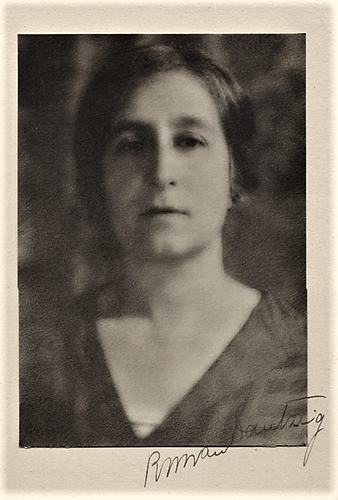
Rachel Margaretha van Dantzig (1878-1949) was a distinguished Dutch sculptor, etcher, and draughtswoman, whose profound contributions to the art world spanned the late 19th and early 20th centuries. Born in Rotterdam, Netherlands, she carved a significant niche for herself in an era when female artists, particularly in the demanding field of sculpture, were a rarity. Her enduring legacy is characterized by a refined figurative style, exceptional craftsmanship, and a deep sensitivity to human and animal forms. Van Dantzig's work, often lauded for its balanced compositions and subtle emotional depth, continues to be recognized for its classical beauty and timeless appeal. Her artistic journey took her across Europe, where she honed her skills and developed a unique artistic voice that seamlessly blended tradition with personal expression.
She passed away in Auderghem, Belgium, leaving behind an oeuvre that attests to her unwavering dedication and keen artistic vision. Rachel van Dantzig's life and work represent a significant chapter in Dutch art history, solidifying her status as a pioneering female artist whose contributions continue to resonate. Her sculptures and graphic works are preserved in notable institutions, serving as a testament to her technical mastery and the enduring power of her artistic interpretations.
Early Life and Education
Rachel Margaretha van Dantzig was born on November 12, 1878, in Rotterdam, Netherlands, to Samuel van Dantzig, a stockbroker, and Adèle Rippe. From an early age, Rachel demonstrated a strong inclination towards the visual arts, setting her on a path that would challenge societal norms for women of her time. Her formal artistic training began in her hometown at the Academie van Beeldende Kunsten in Rotterdam, where she was a pupil of S. Miedema. This foundational education provided her with the technical skills and theoretical knowledge essential for a career in art.
After her initial studies in Rotterdam, Van Dantzig moved to Brussels, a significant step in her artistic development. At that time, women were not yet formally admitted to the prestigious Brussels Academy. Undeterred, Van Dantzig pursued private lessons with the esteemed professor Charles Van der Stappen, a renowned Belgian sculptor. This mentorship proved invaluable, allowing her to gain advanced instruction and refine her sculptural techniques. Following her time in Brussels, she further broadened her artistic horizons by moving to Paris, the epicenter of the art world, where she enrolled at the Académie Colarossi. This institution was known for its progressive approach and openness to female students, providing Van Dantzig with an environment to experiment and grow.
Her education was not limited to formal academy settings. Rachel van Dantzig embarked on extensive study trips throughout Europe and North Africa, including Spain, Morocco, Italy, and Germany. These travels exposed her to diverse artistic traditions, architectural marvels, and cultural influences, profoundly enriching her artistic perspective and shaping her unique style. These experiences allowed her to observe various forms and interpretations of art, which she later incorporated into her own practice.
Artistic Style and Themes
Rachel van Dantzig's artistic style is best described as figurative and classical, yet infused with a personal touch that set her apart. She dedicated herself primarily to sculpture, but was also a skilled etcher and draughtswoman. Her sculptural repertoire predominantly featured human figures, including sensitive portraits, stately busts, and nuanced nudes. She exhibited a remarkable ability to capture not just the physical likeness but also the inner character and emotional depth of her subjects. Her work was celebrated for its meticulous attention to anatomy, balanced compositions, and the subtle expression of emotions, conveying both dignity and a warm, human touch.
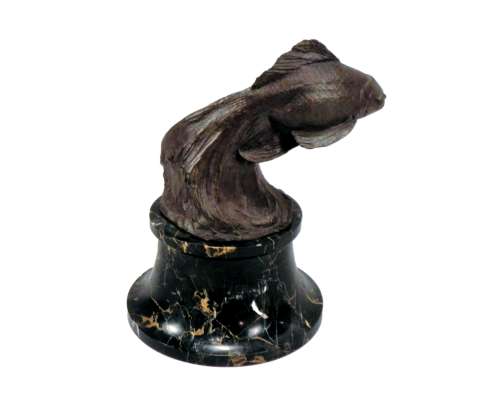
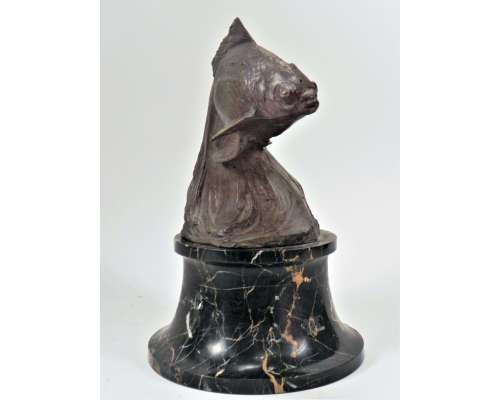
Beyond the human form, Van Dantzig harbored a particular affinity for animal sculpture. Fish, in particular, were a recurring motif in her work, alongside other creatures such as monkeys, birds, and squirrels. These animal studies showcased her keen observational skills and her ability to imbue her subjects with vitality and realism. Her sculptures often displayed a certain fluidity and grace that some scholars suggest may have been influenced by the Belgian Art Nouveau movement, despite her generally academic approach.
As an etcher and draughtswoman, Van Dantzig demonstrated her versatility and mastery of different media. Her two-dimensional works were not merely preparatory sketches but significant artistic endeavors in their own right. Through precise line work and careful composition, she was able to evoke form and atmosphere, using these mediums to develop and deepen her artistic ideas. This multifaceted approach allowed her to explore her artistic vision comprehensively, making her a truly well-rounded artist of her time.
Career and Exhibitions
Upon returning from her extensive study travels, Rachel van Dantzig established her own atelier in Rotterdam, marking the beginning of her professional career. She later moved her studio to 't Hoveke in Sloterdijk, a suburb of Amsterdam. Her career saw her actively participate in the vibrant art scenes of both the Netherlands and Belgium. From 1918 onwards, she primarily lived and worked in Belgium, eventually settling permanently in Brussels (Auderghem) by 1920.
Van Dantzig was a dedicated member of several prominent artists' associations, which provided platforms for her to exhibit her work and engage with her peers. She was a member of Arti et Amicitiae, a prestigious Amsterdam-based artists' society, and a working member of Kunstenaarsvereniging Sint Lucas. Her affiliations also included the Rotterdamse Kunstkring, Kunstenaarsvereniging De Onafhankelijken, and the Nederlandse Kring van Beeldhouwers (NKVB) (Dutch Circle of Sculptors).
Throughout her career, Rachel van Dantzig actively participated in numerous national and international exhibitions. Her work was consistently well-received, earning her several accolades. She exhibited her sculptures and graphic works from as early as 1903 through to 1939. Notably, her work was included in the 1939 exhibition and sale "Onze Kunst van Heden" (Our Art of Today) at the Rijksmuseum in Amsterdam, a significant recognition of her standing in the Dutch art community. She received gold and silver medals in Amsterdam (1913), Rotterdam (1915), and Kortrijk, as well as diplomas of honor at various other exhibitions.
Notable Works and Recognition
Among Rachel van Dantzig's most notable achievements was the marble bust of Hugo de Groot, unveiled in 1913 during the 20th World Congress for Peace held at the Peace Palace in The Hague. This significant commission, gifted to the Carnegie Foundation, is prominently displayed on the upper floor of the palace, opposite the main staircase. The creation of such a public monument underscored her talent and earned her considerable recognition.
In the same year, 1913, Van Dantzig received a prestigious 1st class medal for a sculpture at the exhibition "De Vrouw 1813-1913" (The Woman 1813-1913), further cementing her reputation as a leading sculptor. Another historically significant work is a medal she created in 1919 in honor of the victims of Jewish Pogroms in Eastern Europe, demonstrating her engagement with contemporary social issues through her art.
Other well-known sculptures by Van Dantzig that have appeared at auction include "Squalers" (often referring to her fish sculptures), "Monstre prenant possession d'une femme," "Joueur de flûte," and "Tête de femme". Her sculptures are held in various public collections, including the Drents Museum in Assen, the Jewish Historical Museum in Amsterdam, Museum van Buuren in Brussels, Museum Boijmans Van Beuningen, and the Royal Museum of Fine Arts Antwerp, ensuring her work remains accessible for study and appreciation. The presence of her works in these esteemed institutions highlights her lasting artistic value and historical importance.
Personal Life
Beyond her public artistic endeavors, Rachel van Dantzig's personal life also showcased a spirit of independence and modernity. She was the daughter of Samuel van Dantzig and Adèle Rippe, and her family included a sister, Margaretha, a violinist, who tragically died in Sobibór extermination camp in 1943. Van Dantzig maintained a long-term relationship with the painter and singer Alice Plato (1875-1968). The couple lived together for a period in Sloterdijk, and they are reportedly interred together, reflecting a deep personal connection that transcended societal conventions of their time. This aspect of her life provides a more intimate glimpse into the woman behind the artist, revealing her strength and commitment in both her personal and professional spheres.
Legacy and Enduring Influence
Although Rachel van Dantzig passed away in 1949, her legacy as a pioneering Dutch sculptor, etcher, and draughtswoman continues to be recognized and celebrated. Her work is valued for its exceptional craftsmanship, classical beauty, and honest portrayal of her subjects. As a female artist who succeeded in the traditionally male-dominated field of sculpture, she paved the way for future generations of women in art, serving as an inspiring figure.
Her careful, human-centered approach to art resulted in a refined and authentic body of work that still testifies to her dedication, technical expertise, and keen eye for the human scale. The continued presence of her sculptures in prominent museums and their appearance at international auctions, with works such as "Fishes" achieving notable prices, underscore the ongoing appreciation for her artistic contributions. Rachel van Dantzig's influence extends beyond her lifetime, as her art serves as a timeless testament to her talent and perseverance, ensuring her place in the annals of Dutch and European art history.

 EN
EN  NL
NL FR
FR