Henri-Joseph Duwez, also known as Duwée Henri-Joseph, was a distinguished Belgian painter and engraver whose artistic career spanned the mid-19th century. Born in Brussels on September 24, 1810, Duwez emerged from a family of modest means, with his father, Jean Adrien Duwée, working as a cooper, and his mother, Jeanne Françoise D'Haese, as a merchant. His foundational years and artistic training would lay the groundwork for a prolific career, even if his legacy has become somewhat overlooked in contemporary times. Duwez dedicated his life to the arts, leaving behind a body of work characterized by its classical roots infused with a distinctive personal touch.
Early Life and Artistic Education
Henri-Joseph Duwez spent his early life in his birthplace of Brussels, residing at Rue du Marché aux Fromages no 21 until around 1870. His formal artistic journey began at the prestigious Royal Academy of Fine Arts in Brussels, a pivotal institution for aspiring artists of the era. Here, he had the privilege of studying under the esteemed neo-classical painter Jean-François Navez. Navez's influence would undeniably shape Duwez's approach to form, composition, and the classical ideals that permeated much of 19th-century European art.
His dedication and talent were recognized early in his academic career. During the Academy's competition for the academic year 1832-1833, Duwez secured the second accessit in the living model class, a testament to his burgeoning skill and potential. This early acknowledgment provided a strong foundation as he transitioned from student to professional artist, beginning his active period around 1833. He remained an active creator, consistently producing and exhibiting works until at least 1870.
Artistic Style and Themes
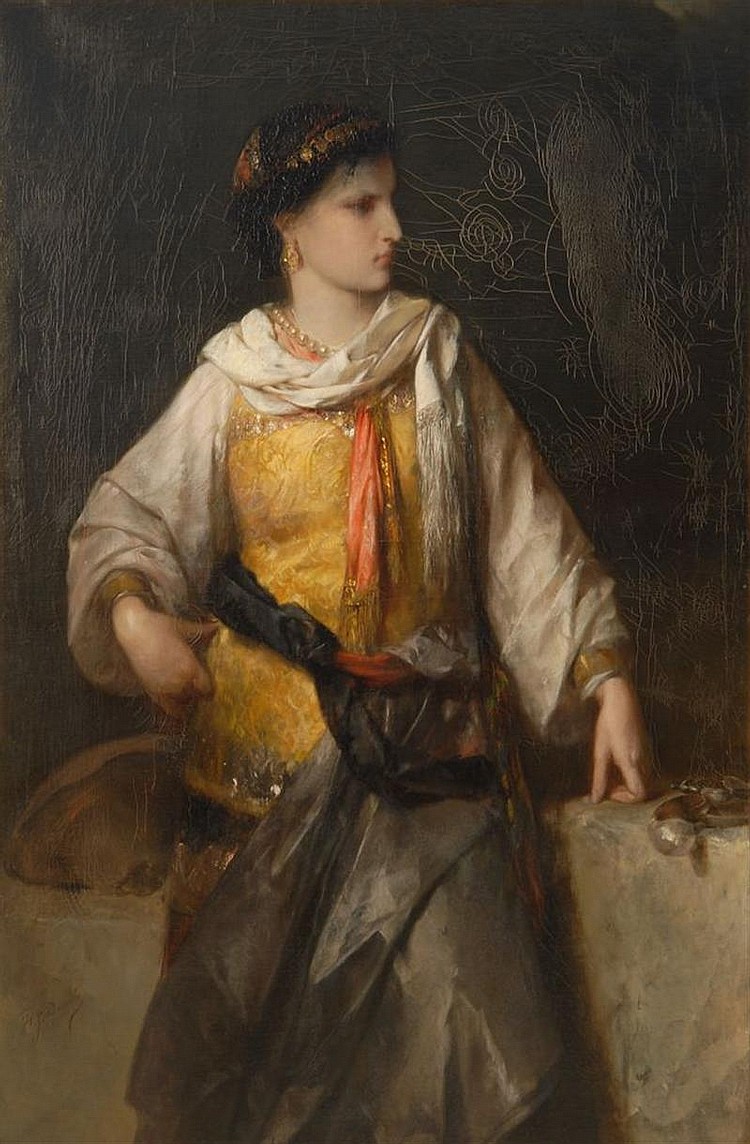
Duwez Henri-Joseph carved out a unique space within the classical traditions of his time. His artistic repertoire was diverse, encompassing historical paintings, religious subjects, genre scenes depicting everyday life, and a number of portraits. While his work often presented a classical style, he was celebrated for imbuing his canvases with a personal touch that set him apart from his contemporaries. This individuality was manifest in his striking use of light and shadow, and his innovative compositional techniques.
A hallmark of Duwez's style was his mastery of chiaroscuro, a technique that employs strong contrasts between light and dark to create dramatic effect and volume. Beyond this, he developed a distinctive approach where he would render certain areas of a painting with exceptional clarity and meticulous detail, while intentionally blurring or softening other parts, achieving an almost sfumato-like effect. This selective focus, akin to a photographic lens concentrating on a specific subject, allowed him to guide the viewer's eye and immediately draw attention to the central elements of his scenes. This "photographic effect" was remarkably ahead of its time, foreshadowing techniques that would be explored by great masters of photography decades later.
His thematic choices reflected the academic tastes of the 19th century, with a strong inclination towards narratives that evoked emotion, historical significance, or moral introspection. Whether depicting dramatic moments from history, poignant religious narratives, or intimate genre scenes, Duwez's compositions consistently demonstrated a thoughtful engagement with his subjects, always striving to tell a compelling visual story through his intricate brushwork and lighting.
Notable Paintings and Engravings
Throughout his career, Henri-Joseph Duwez produced numerous works that gained recognition and were exhibited in prominent Salons across Belgium, France, and the Netherlands. One of his most renowned paintings, "Woman with a Tambourine" (1858), stands as a significant example of his genre painting and is proudly held in the collection of the Rijksmuseum in Amsterdam. This painting exemplifies his ability to capture both detail and atmosphere within a single frame.
Another frequently cited work is "Alone in the world" (also known as "Seule au monde"), an oil on panel that has appeared in historical sales, including one in Paris on February 6, 1895, at Drouot. This painting is often referenced when discussing his dramatic style and emotional depth. It was exhibited at the Brussels Salon in 1869 under the French title.
Duwez was also an accomplished engraver. Among his notable engravings is "Lamme Goedzak" (1867), which, like his painting "Woman with a Tambourine," is part of the Rijksmuseum Amsterdam's collection. His engraving skills also extended to illustration; he contributed drawings to the satirical weekly *Le Charivari* in 1839 and illustrated Charles De Coster's *Les Contes brabançons* in 1867, placing him alongside other notable artists like Félicien Rops in this publication.
Selected Exhibitions and Recognition
Duwez was a regular participant in the Salons, which were crucial platforms for artists to display their work and gain public and critical acclaim during the 19th century. His exhibition history includes:
- Brussels Salon of 1839: "Le Christ au tombeau" (Christ in the Tomb).
- Brussels Salon of 1842: "Henri IV, empereur d'Allemagne, excommunié par le souverain pontife Grégoire VII" (Henry IV, Emperor of Germany, Excommunicated by Pope Gregory VII) and "Jeanne d'Arc" (Joan of Arc).
- Brussels Salon of 1845: "Douleur et résignation" (Sorrow and Resignation) and a Portrait.
- Brussels Salon of 1851: "Le Christ tombant sous la croix" (Christ Falling Under the Cross).
- Brussels Salon of 1860: "Besoin cherche consolation" (Need Seeks Consolation).
- Antwerp Salon of 1864: "Bravo" and a Portrait.
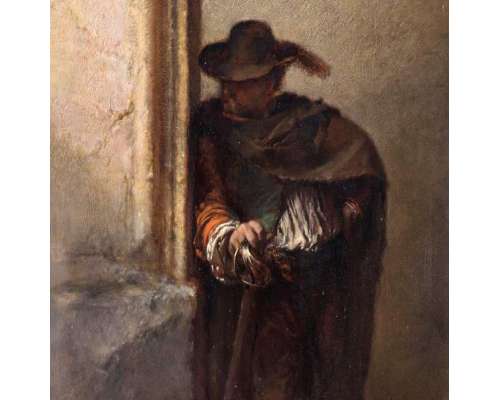
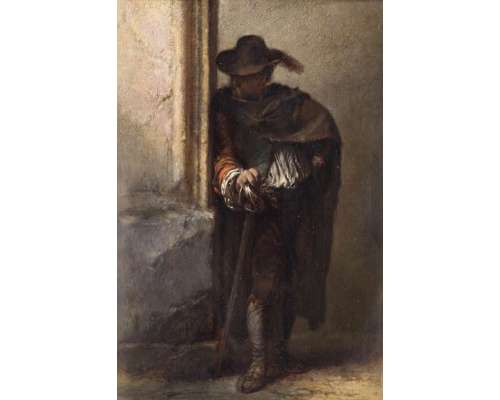
- Brussels Salon of 1866: "Un bravo," which was notably acquired by Philippe, Count of Flanders, a significant form of royal patronage and recognition.
- Antwerp Salon of 1867: "Les Suites de l'orgie" (The Consequences of the Orgy).
- Brussels Salon of 1869: "Seule au monde" (Alone in the World).
- Brussels Salon of 1872: "La Grève amène la misère" (The Strike Brings Misery) and "Coupe-jarret" (Cutthroat).
- Antwerp Salon of 1873: "Un passage dangereux" (A Dangerous Passage).
- Brussels Salon of 1875: "Enfant abandonné" (Abandoned Child) and "La Femme au bravo" (The Woman with the Bravo).
His portraits of Herminie Dansaert (1840) and Eugène Charles Emmanuel Dansaert (1841) are preserved in the Musée de la Ville de Bruxelles, further demonstrating his presence in notable public collections. While no modern "awards" are listed, the acquisition of his work by a member of the Belgian royal family signifies considerable esteem within his lifetime.
Legacy and Conclusion
Henri-Joseph Duwez passed away on December 21, 1883, in Forest, Belgium, at the age of 73. He had married Marie Anne Arnouts in Forest on September 19, 1878. Despite his prolific output and the distinctiveness of his style, much like many talented artists of his era, Duwez is now considered by some sources to be a "talented but now almost forgotten painter." However, his works continue to be valued in art markets and are preserved in significant institutions such as the Rijksmuseum Amsterdam and the Musée de la Ville de Bruxelles.
His contribution to 19th-century Belgian art, particularly his innovative use of chiaroscuro and his "photographic" approach to composition, offers valuable insights into the evolving artistic sensibilities of the period. Duwez Henri-Joseph remains an important figure for those studying the classical and genre painters of the 19th century, representing an artist who, through a personal touch, brought new dimensions to established styles. His enduring presence in museum collections ensures that his unique vision continues to be appreciated by art enthusiasts and scholars alike.

 EN
EN  NL
NL FR
FR