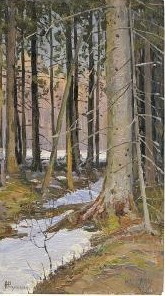
Riznischenko Feodor Petrovich (1865 - 1922)
Feodor Petrovich Riznichenko, often recognized by the alternative spelling Riznischenko, was a distinguished Russian and Ukrainian landscape painter whose artistic career spanned the late 19th and early 20th centuries. Born in 1865, he left an indelible mark on the art world with his lyrical interpretations of nature, deeply rooted in the traditions of his homeland. His work continues to be admired for its evocative beauty and profound connection to the landscapes he depicted. He passed away in 1922, leaving behind a rich legacy of captivating canvases that reflect the spirit of his era.
Riznichenko's contributions were particularly significant within the context of the Russian art movement, where he stood out as a landscape artist of considerable talent. His paintings are characterized by a keen observational eye and a poetic sensibility, capturing the subtle nuances of light, atmosphere, and the changing seasons. His artistic journey was deeply intertwined with prominent art societies and exhibitions, which provided him platforms to showcase his evolving style and connect with a wider audience and fellow artists during his active years.
Early Life and Artistic Formation
Details regarding Feodor Petrovich Riznichenko's early life and specific artistic training are somewhat sparse in readily available records, yet it is evident that he developed a strong foundation in painting during a vibrant period for Russian art. Born in 1865, his formative years would have been shaped by the cultural and artistic currents sweeping across the Russian Empire and Ukraine. It is generally understood that artists of his caliber typically underwent rigorous academic training, often at institutions like the Imperial Academy of Arts in St. Petersburg, although direct confirmation of his enrollment details remains elusive from initial searches. His command of technique and deep understanding of landscape composition suggest formal instruction or extensive self-study.
The late 19th century was a time of significant artistic development, with a growing emphasis on depicting national identity and the natural beauty of the Russian and Ukrainian countryside. Young artists like Riznichenko were exposed to a diverse range of influences, from established academic styles to the burgeoning realist movements. This environment would have undoubtedly played a crucial role in shaping his artistic sensibilities and his decision to specialize in landscape painting, a genre highly esteemed for its ability to convey emotion and connection to the land. His early experiences likely instilled in him the appreciation for the subtle grandeur of nature that would become the hallmark of his later works.
Artistic Style and Influences
Feodor Petrovich Riznichenko established himself firmly within the revered tradition of the Russian lyrical landscape. This style, characterized by its emotional depth, poetic interpretation, and focus on capturing the transient moods of nature, found its foundational exponents in artists such as Alexei Savrasov and Isaac Levitan. Riznichenko absorbed these influences, integrating them into his unique artistic voice to create canvases that resonate with a quiet beauty and profound sense of place. His landscapes often evoke a feeling of introspection and a deep appreciation for the subtle grandeur of the natural world, moving beyond mere topographical representation to achieve an emotional resonance.
The hallmarks of Riznichenko's style include a masterful handling of light, which he used to define forms, create atmosphere, and convey the time of day or season. His palette often featured subdued yet rich tones, allowing for a naturalistic portrayal of the Russian and Ukrainian scenery. He had a particular talent for capturing the delicate interplay of light and shadow, and the changing textures of foliage, water, and sky. Whether depicting a serene riverbend under moonlight or a sun-dappled forest path, his works exude a sense of tranquility and an intimate understanding of his subjects. This approach aligns perfectly with the lyrical tradition, where the artist's personal feeling towards the landscape is paramount.
His connection to the Peredvizhniki, or the "Itinerants" movement, further contextualizes his artistic leanings. This group of Russian realist artists, active in the late 19th century, sought to break away from academic strictures and bring art closer to the people by depicting everyday life, historical events, and, significantly, the Russian landscape. While Riznichenko's primary focus was landscape, his association with the Peredvizhniki exhibitions indicates his alignment with their broader ideals of national art and accessibility, distinguishing him as an artist engaged with the cultural pulse of his time.
Exhibitions and Recognition
Feodor Petrovich Riznichenko was an active and recognized figure within the artistic circles of his time. He was a proud member of the St. Petersburg Society of Artists, an important affiliation that connected him with a community of peers and provided opportunities for exhibition and collaboration. His involvement with such societies was instrumental in showcasing his developing talents and gaining visibility for his landscape paintings, which were steadily growing in popularity and critical acclaim.
One of the most significant aspects of his career was his regular participation in the Peredvizhniki exhibitions. These traveling exhibitions were vital for bringing art to a broader audience across the Russian Empire, solidifying Riznichenko's reputation as a committed and accomplished artist. His consistent presence in these prestigious shows underscores the quality and appeal of his work to both critics and the public. His paintings contributed to the collective artistic discourse of the era, enriching the understanding and appreciation of Russian landscape art.
Riznichenko's talent did not go unnoticed, and he received several notable accolades throughout his career. These included a bronze medal in 1887, followed by silver medals in 1889, 1892, and 1894. These awards were significant markers of official recognition and served to validate his artistic prowess and dedication. Such distinctions, awarded by academic bodies or exhibition juries, were highly coveted and testified to his rising prominence within the Russian art establishment.
A crowning moment in his career was the solo exhibition of his works hosted by the Imperial Academy of Arts in 1911 as part of their autumn exhibition. A solo show at such a venerable institution was a profound honor, signifying his mastery and the significant regard in which his art was held. This exhibition provided an expansive platform for Riznichenko to present a comprehensive collection of his landscapes, further cementing his place among the respected artists of his generation and allowing the public to fully immerse themselves in the breadth of his artistic vision.
Key Works
While Feodor Petrovich Riznichenko did not produce "albums" in the musical sense, his body of work comprises a rich collection of oil paintings that beautifully encapsulate the Russian and Ukrainian landscape. His artistic output is characterized by a consistent theme of natural beauty, often imbued with a sense of calm and a masterful play of light and shadow. Each canvas represents a distinct chapter in his visual "discography," offering viewers a window into his artistic journey and his enduring fascination with the natural world. These works are his true legacy, showcasing his skill and sensitivity as a landscape painter.
Among his noted works is "View of an Undergrowth," painted in 1901. This piece exemplifies his ability to capture the intimate details of a forest scene, bringing to life the textures and light filtering through dense foliage. Another significant painting is "Sleigh Ride through the Winter Village," created in 1912. This work likely showcases his capacity to portray the unique beauty and atmosphere of winter, a common and beloved theme in Russian landscape art, reflecting the harsh yet picturesque realities of the region's climate. His winter scenes are often celebrated for their evocative sense of quietude and shimmering snowscapes.
Other notable creations include "Clair de lune sur le Dniepr," which highlights his skill in depicting nocturnal scenes and the reflective qualities of water under moonlight. The Dniepr River, a major waterway in Eastern Europe, would have provided a powerful and symbolic subject for an artist connected to both Russian and Ukrainian identities. "Vorfrühling" (Early Spring), dated 1909, demonstrates his sensitivity to seasonal transitions, capturing the delicate awakening of nature after winter. These transitional periods, full of subtle color shifts and emerging life, were often favored by lyrical landscape painters for their symbolic depth.
Riznichenko also explored themes of rural life, as seen in "Girl with Geese on a Village Road," painted in 1912. Such works often blend landscape with anecdotal elements, providing a glimpse into the harmonious relationship between people and their environment. His landscape versatility is further evidenced by "Reife Kornfelder in ukrainischer Landschaft" (Ripe Cornfields in Ukrainian Landscape), showcasing the bountiful agrarian beauty of Ukraine. This painting would likely feature expansive fields, perhaps under a clear summer sky, celebrating the fertility and vastness of the Ukrainian countryside.
His broader geographical interests are reflected in paintings such as "The foothills of the Caucasus" and "Carpathians," indicating his ventures beyond the immediate central Russian and Ukrainian plains. These works would have presented opportunities to explore more dramatic and mountainous terrains, expanding his thematic range. Further examples like "Ukrainian Hut near a Pond at Night," "Fishermen's cottages," "A spring landscape," "Late summer landscape with a lake," and various river landscapes, including "River in moonlight landscape" and "Landscape with boat," illustrate his consistent dedication to capturing diverse natural settings and the peaceful coexistence of human elements within them. "Sunny Day in Early Spring" also captures a specific seasonal mood. More recently, "View from a villa by the sea" has appeared in auction, demonstrating his breadth of subject matter, extending to coastal scenes.
Legacy and Market Presence
Despite his passing in 1922, Feodor Petrovich Riznichenko's artistic legacy continues to thrive, resonating with art historians, collectors, and enthusiasts alike. His paintings are enduring testaments to the lyrical landscape tradition, admired for their technical mastery and emotional depth. Riznichenko's works are held in various private collections and potentially public institutions, ensuring their preservation and continued study. The sustained interest in his art underscores his lasting contribution to the pantheon of Russian and Ukrainian painters, cementing his status as a significant figure whose vision of nature remains compelling.
In the contemporary art market, Riznichenko's paintings frequently appear at auctions, a clear indicator of their continued desirability and artistic value. Recent years have seen several of his works successfully change hands, demonstrating a steady demand. For instance, his painting "Clair de lune sur le Dniepr" was offered for sale in July 2020, fetching a notable price that reflects its quality and provenance. Such transactions highlight the ongoing appreciation for his unique style and historical importance.
Further demonstrating this enduring market presence, "Sleigh Ride through the Winter Village" was sold in November 2019, and "Vorfrühling" in May 2018. More recently, a "View from a villa by the sea" was part of an auction in March 2023, and "River in moonlight landscape" has also been featured on auction platforms. These consistent appearances and sales at various auctions, including online platforms, affirm that his art maintains its relevance and commands significant attention from collectors worldwide. The consistent sale of his works well into the 21st century serves as a powerful testament to the timeless appeal of his landscape paintings and his enduring legacy as a master of the genre.

 EN
EN  NL
NL FR
FR