Louis Amable Schneider (1824 - 1884)
Louis Amable Schneider, a distinguished French painter, engraver, and illustrator, left an indelible mark on 19th-century art through his diverse body of work. Born in Paris in 1824, his artistic journey began under the tutelage of notable masters, shaping a versatile talent that would later earn him recognition at the prestigious Salon de Paris.
Schneider's oeuvre encompasses a range of subjects, from deeply religious themes in his engravings to captivating genre scenes and pastoral landscapes in his paintings. His career, spanning several decades, was characterized by a meticulous approach to detail and a profound understanding of composition, reflecting the academic traditions of his time while hinting at the evolving artistic sensibilities of the era.
Early Life and Artistic Formation
Born in the vibrant artistic hub of Paris in 1824, Louis Amable Schneider embarked on his artistic education at an early age. He had the privilege of studying under the guidance of respected artists Martin Drolling and Fournier. These formative years were crucial in developing his foundational skills in painting, drawing, and engraving, laying the groundwork for his future multifaceted career.
The education received from Drolling and Fournier, both established figures in the French art scene, provided Schneider with a strong academic background. This training emphasized classical techniques, observational drawing, and a disciplined approach to art creation, which would remain evident throughout his professional life. His early exposure to formal artistic instruction instilled in him a deep appreciation for technique and narrative.
Paris in the mid-19th century was a melting pot of artistic ideas, and this environment undoubtedly influenced young Schneider. While details of his earliest works are scarce, it is reasonable to infer that his initial studies involved mastering portraiture, still life, and historical subjects, which were standard components of academic art curricula during that period.
Artistic Style and Themes
Louis Amable Schneider's artistic style is best described as rooted in the academic traditions of the 19th century, characterized by realism, attention to detail, and often a narrative quality. He skillfully navigated between different mediums, showcasing a consistent artistic vision. His oil paintings often depicted tranquil genre scenes, rural landscapes, and sometimes portraits, imbued with a gentle, often idyllic quality.
In his engravings, Schneider frequently explored religious themes. Works such as "The Coronation of Mary" and "St Francis of Assisi" are noted as significant examples of his devotional output in this medium. These pieces demonstrate his ability to convey spiritual depth and intricate symbolism through line and shadow, appealing to the religious sensibilities of the time.
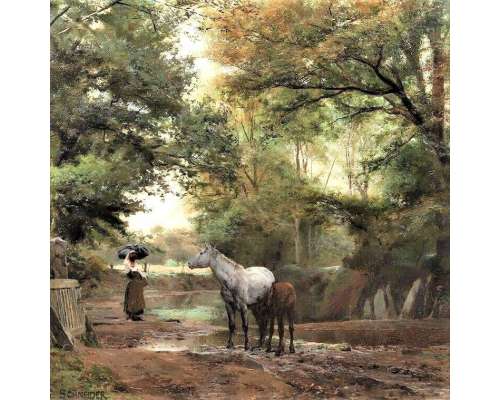
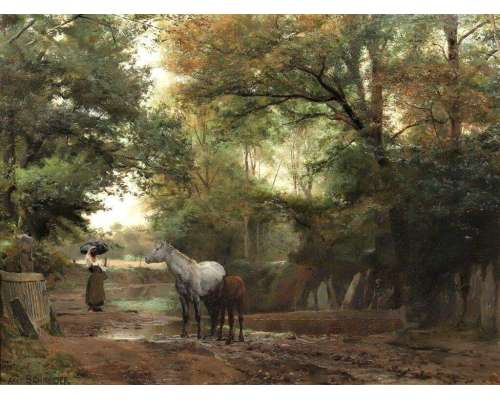
His genre paintings often captured everyday life, depicting figures in various settings, sometimes with an underlying narrative. These scenes were often rendered with a sense of quiet observation and a warm, inviting palette. Examples include "Southern farmstead with peasant woman and cattle" and "Shepherd Scene with a Peasant Woman on the Bank of a River", showcasing his ability to depict rural life with authenticity and charm.
Schneider's illustrations, though less documented individually, would have complemented his work as an engraver, likely contributing to books, periodicals, and other printed materials popular in the 19th century. This versatility across painting, engraving, and illustration underscored his comprehensive artistic skill and adaptability.
Major Works and Exhibitions
Louis Amable Schneider began exhibiting his works at the prestigious Salon in Paris starting in 1861, a crucial step for any artist seeking recognition in 19th-century France. His debut at the Salon was met with immediate success, an impressive feat for an emerging artist.
Among his most significant contributions are his engravings, which often centered on religious subjects. "The Coronation of Mary" and "St Francis of Assisi" stand out as notable examples of his mastery in this medium, demonstrating his deep engagement with sacred narratives and his refined technical skill.
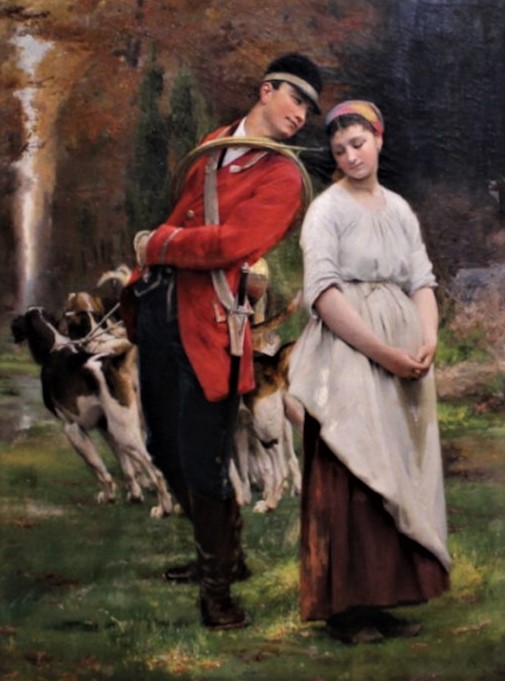
His paintings, while perhaps not as extensively cataloged as his engravings in some historical accounts, include genre scenes and landscapes that have appeared in auction records. Works such as "Chasseur avec filles et chiens" (Hunter with Girls and Dogs), "Südliches Gehöft mit Bäuerin und Vieh" (Southern farmstead with peasant woman and cattle), and "Shepherd Scene with a Peasant Woman on the Bank of a River" offer glimpses into his painted repertoire.
These paintings often depict serene rural environments and everyday interactions, rendered with a keen eye for detail and a warm, evocative atmosphere. The appearance of these works at various auctions over the years, even posthumously, indicates a continued interest in his painterly output.
Awards and Recognition
Louis Amable Schneider achieved significant recognition early in his career. Upon his first exhibition at the Salon in Paris in 1861, he was awarded a third-class medal. This award was a considerable achievement and an immediate validation of his artistic talent and promise.
The Salon de Paris was the official art exhibition of the Académie des Beaux-Arts, and a medal from this institution was a highly coveted honor that could significantly boost an artist's career and reputation. Schneider's success in this competitive environment affirmed his standing among his contemporaries.
While specific details of further awards or extensive critical reviews from his lifetime are not readily available in common records, his consistent presence at the Salon and the enduring appeal of his works, as evidenced by their presence in collections and at auctions, suggest a sustained level of appreciation for his artistry throughout his life and beyond. The fact that his works continue to be sold and discussed in art circles further speaks to his lasting, albeit perhaps understated, legacy.
Legacy and Influence
Louis Amable Schneider passed away in 1884, leaving behind a legacy as a versatile French artist who excelled as a painter, engraver, and illustrator. While not a revolutionary figure who broke dramatically with artistic traditions, his work embodies the refined craftsmanship and thematic interests prevalent in 19th-century French academic art.
His careful execution, particularly in his detailed engravings of religious subjects and his serene genre paintings, offers valuable insight into the artistic tastes and cultural values of his era. Schneider's contributions helped to preserve and transmit popular themes, both sacred and secular, through accessible visual forms.
Posthumously, Schneider's works continue to circulate within the art market. His paintings and engravings periodically appear at auctions, attracting collectors and enthusiasts interested in 19th-century French art. This ongoing market presence ensures that his name and artistic output remain known and appreciated by a discerning audience.
The documentation of his life and career, though perhaps not as exhaustive as that of some more overtly celebrated figures, is maintained in art databases and biographical entries, testifying to his established place within the broader history of French art. He represents a skilled practitioner of his time, contributing to the rich tapestry of artistic production during a period of significant change and development in European art.

 EN
EN  NL
NL FR
FR