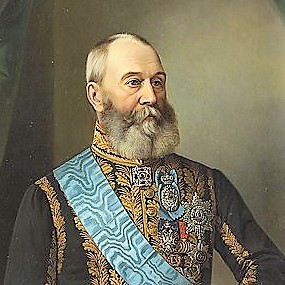
Bothmann Georg von (1810 - 1891)
Georg von Bothmann, born on February 26, 1810, in Lübeck, Germany, was a distinguished portrait painter whose artistic journey led him to the esteemed Imperial Russian Court in St. Petersburg. His career spanned a significant period of the 19th century, marking him as a notable figure in both German and Russian art history. Bothmann's life and work are characterized by his remarkable talent for capturing the likeness and essence of his subjects, particularly the powerful figures of the Russian aristocracy and imperial family. He achieved considerable recognition during his lifetime, a testament to his skill and the demand for his elegant and precise portraiture.
The artist's oeuvre provides valuable insight into the visual culture and social dynamics of the Russian Empire during the reigns of Emperors Nicholas I and Alexander II. His paintings serve not only as artistic expressions but also as historical documents, preserving the images of influential individuals who shaped an era. Bothmann's legacy is firmly established within major art institutions, where his works continue to be studied and admired for their historical and aesthetic significance. He passed away on September 18, 1891, in Dresden, Germany, leaving behind a rich collection of works that define his contribution to the art world.
Early Life and Education
Georg von Bothmann's formative years began in his birthplace of Lübeck, a historic city in northern Germany. Details concerning his early artistic training are somewhat sparse in extant records, yet it is evident that he received a comprehensive education in the principles of painting that prepared him for a successful professional career. Artists during this period often apprenticed under established masters or attended reputable art academies to hone their craft. It is plausible that Bothmann underwent such rigorous training, developing the foundational skills in drawing, composition, and color theory that would become hallmarks of his later work.
The artistic environment of early 19th-century Germany was vibrant, influenced by various movements including Romanticism and Classicism. Bothmann would have been exposed to these diverse styles, potentially integrating elements into his developing personal aesthetic. His early experiences undoubtedly laid the groundwork for his specialization in portraiture, a genre that demanded not only technical prowess but also a keen understanding of human psychology and social presentation. The precision and attention to detail evident in his mature works suggest a disciplined and thorough artistic upbringing.
Move to Russia and Imperial Recognition
A pivotal moment in Bothmann's career was his relocation to the Russian Empire, a move that placed him at the heart of one of Europe's most powerful and culturally rich courts. While some historical accounts mistakenly place his arrival in Russia in 1846, evidence from his dated works, specifically a family portrait from 1845, confirms he was active there at least a year earlier. This timely move allowed him to establish himself within the imperial capital, St. Petersburg, a city that was a burgeoning center for arts and culture, attracting talent from across the continent.
Bothmann quickly garnered attention for his exceptional talent, leading to commissions from the highest echelons of Russian society. His artistic breakthrough came with the portrait of Tsar Nicholas I, a monumental achievement that secured his position and reputation. For this significant work, Georg von Bothmann was bestowed with the prestigious title of "Imperial Russian Court Painter," a designation that underscored his official status and the high regard in which his work was held by the imperial family.
Further solidifying his standing within the artistic establishment, Bothmann was also granted membership to the esteemed Academy of Arts in St. Petersburg. By 1853, he had been formally recognized as an academician of the Imperial Academy of Arts, a testament to his mastery and contribution to the arts. This elevation in status not only provided him with considerable prestige but also likely brought further commissions and opportunities, cementing his role as a prominent artist at the Russian court for many years. His success also translated into financial prosperity, as he was commercially successful and owned an income-generating property in St. Petersburg.
Artistic Style and Subjects
Georg von Bothmann's artistic style was firmly rooted in the traditions of 19th-century portraiture, characterized by a blend of realism, dignity, and meticulous detail. His works often conveyed the grandeur and formality expected of imperial and aristocratic sitters, yet also managed to imbue his subjects with a sense of individual character. He excelled at creating ceremonial portraits, capturing the official bearing and attire of military leaders and dignitaries with remarkable precision.
His technique involved a careful application of oil paints, resulting in smooth finishes and a vibrant, yet restrained, color palette. Bothmann's ability to render textures, from the intricate lacework of noble attire to the gleaming medals of military uniforms, speaks to his technical proficiency. The poses he chose for his sitters were typically formal and composed, reflecting the social conventions of the era and the desire to present an image of authority and status. His portraits were not merely likenesses but statements of power and position.
The bulk of Bothmann's artistic output was dedicated to portraying the most influential figures of his time within the Russian Empire. His most notable subjects included the Russian Tsars Nicholas I and Alexander II, whom he painted on multiple occasions, sometimes varying their military uniforms to create distinct official portraits. Beyond the imperial family, he depicted a wide array of Russian nobility, admirals, and military officers, effectively creating a visual chronicle of the court and its most prominent members. These portraits are invaluable for understanding the sartorial and social aesthetics of 19th-century Russia.
Notable Works and Collections
Bothmann Georg von's extensive body of work is preserved in some of Russia's most prestigious cultural institutions, underscoring his enduring importance. His paintings are prominently featured in the collections of the State Hermitage Museum, one of the largest and oldest museums in the world, the Central Naval Museum, and the Russian Museum, all located in St. Petersburg.
Among his significant contributions are several portraits of the aforementioned Tsars. For instance, multiple portraits of Emperor Nicholas I, sometimes subtly differing in military attire, were painted by Bothmann throughout his career. Similarly, he produced several portraits of Emperor Alexander II. The Central Naval Museum houses a notable collection of eight portraits of Russian admirals executed by Bothmann, offering a comprehensive view of the naval leadership of the period.
Other specific works include a portrait of Count Alexander von Benckendorff, which is displayed in the halls of the State Hermitage Museum, and a portrait of Prince Illarion Vasilievich Vasilchikov. The "Portrait of the Andreas Matthiessen Family," dated 1845, is also a well-documented work, notable for proving his earlier arrival in Russia. These works, along with countless other portraits of the nobility and military, form a crucial visual record of imperial Russia, reflecting Bothmann's prolific output and consistent demand. His works occasionally appear on the art market, with auction results demonstrating continued interest in his historical portraits.
Legacy and Posthumous Recognition
Though Georg von Bothmann’s active career concluded with his passing in 1891, his legacy as a significant portrait artist of the Imperial Russian Court continues to resonate. His contributions are not measured by modern awards or contemporary tours, which are anachronistic for an artist of his period, but by the lasting presence of his works in major museum collections and their historical value. The fact that his paintings are held in institutions like the Hermitage, the Naval Museum, and the Russian Museum speaks volumes about their historical and artistic importance.
Bothmann's work remains a vital resource for art historians and researchers studying 19th-century European and Russian portraiture, as well as those interested in the visual representation of the imperial family and aristocracy. His ability to capture not just the physical likeness but also the societal status and character of his sitters provides invaluable insights into the social fabric of his time. The preservation of his grave in the Old Annen Cemetery in Dresden further signifies his recognized place in art history.
In the modern art market, Bothmann's paintings occasionally come up for auction, demonstrating a sustained interest from collectors and institutions alike. For instance, "Portrait of the Andreas Matthiessen Family" achieved a notable price at auction in 2018, indicating the continued value and appreciation for his work. This ongoing presence in the art market, coupled with his permanent display in prestigious museums, ensures that Georg von Bothmann's artistic achievements and his role as a chronicler of imperial Russia remain recognized and celebrated for generations to come.