Biography

Feldhütter Ferdinand (1842-1898)

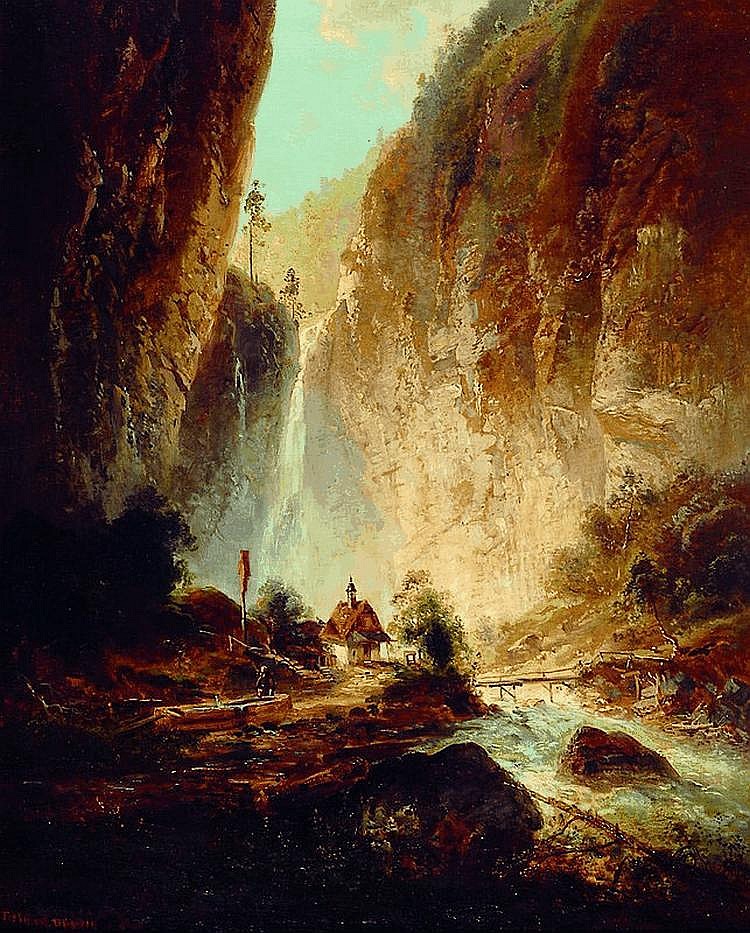
Ferdinand Feldhütter (born April 7, 1842, in Munich – died December 8, 1898, in Munich) was a renowned 19th-century German landscape painter, celebrated for his idyllic depictions of the Bavarian Alps, Tyrol, Switzerland, and northern Italy. Largely self-taught in his early years, he specialized in atmospheric mountain and lake scenes, influenced by artists such as Julius Lange and echoes of Carl Spitzweg. His works were frequently exhibited at the Munich Kunstverein and captured the poetic beauty of Alpine landscapes with a realistic yet romantic touch.

Early Life and Training

Born to modest parents in Munich, a city to which he remained deeply attached throughout his life, Ferdinand Feldhütter initially worked as a folk singer (Volkssänger). He later trained as a decorative painter and roller painter (Dekorations- und Rouleaumaler). A frequent visitor to Munich's museums, he began painting landscapes as a self-taught artist.

He subsequently became the private pupil of landscape painter Julius Lange, whose influence is evident in his idyllic compositions. Without formal academic training, Feldhütter developed a personal style rooted in his profound love for Bavarian nature.

Artistic Career

Ferdinand Feldhütter devoted himself exclusively to Alpine landscape painting. His favorite subjects included lakes and mountains in Bavaria (Chiemsee, Königssee, Walchensee), Tyrol, Switzerland (Lake Lucerne, Lake Hallstatt), and northern Italy (Lake Maggiore).

Notable works include:

  • The Walchensee (1877)
  • Lake Lucerne (1881)
  • Lake Hallstatt (acquired by the Munich Kunstverein in 1898)
  • Mountain Gorge (1884)
  • Scene near Inzell and Mauthhäusel (Berchtesgaden region)
  • The Hohe Göll near Berchtesgaden
  • View of Lake Maggiore (exhibited posthumously in 1899)

One of his paintings, Scene from Sachrang near Kufstein, won a gold medal at the international exhibition in Barcelona in 1898. His canvases were regularly shown in major German exhibitions and at the Munich Kunstverein, of which he was a member. Some works were reproduced in publications like Die Gartenlaube and Über Land und Meer.

One of his paintings was part of the collection of Prince Regent Luitpold of Bavaria.

Personality and Later Years

Ferdinand Feldhütter was known for his cheerful disposition, humor, and active participation in Munich's artistic scene. He often entertained artist gatherings with Tyrolean yodels and humorous anecdotes.

In autumn 1898, he stayed at the Chiemsee seeking fresh inspiration, but an old heart condition worsened, leading to his death on December 8, 1898, in Munich.

Legacy

Today, Ferdinand Feldhütter's paintings are highly sought after on the art market for their faithful and poetic representations of 19th-century Alpine landscapes. His works appear in private and public collections and are frequently offered at auctions.

For more on Ferdinand Feldhütter painter, his Bavarian landscapes, or Alpine paintings, consult sources like the Deutsche Biographie or specialized auction catalogs. His oeuvre remains a valuable testament to German landscape painting of the 19th century.

Close filter window

Product added to wishlist