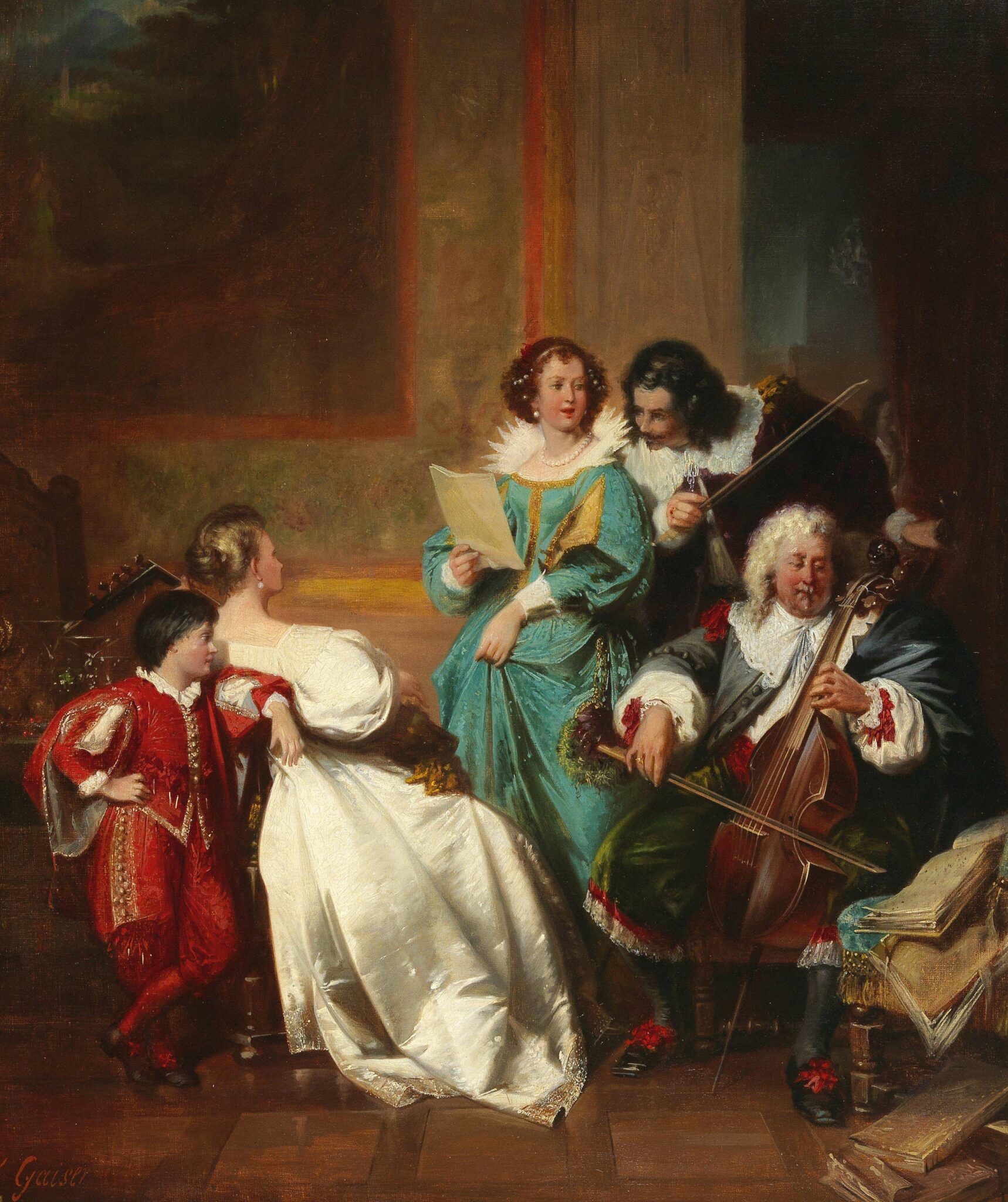
Jakob Emanuel Gaisser (1825 - 1899)
Jakob Emanuel Gaisser, a prominent German genre painter of the 19th century, left behind a rich artistic legacy characterized by his vivid depictions of historical and everyday life. Born in Augsburg in 1825, Gaisser's artistic journey spanned several decades, culminating in a distinctive style that resonated with the public of his time. His works often captured the essence of 17th and 18th-century Dutch painting, infused with a narrative quality and sometimes a critical undertone. Through his diligent study and dedication, Gaisser established himself as a respected figure in German art.
His career was marked by a commitment to genre scenes, a popular artistic category that allowed him to explore themes of social interaction, domestic life, and historical narratives. Gaisser's skill in rendering detailed compositions and expressive figures contributed to the enduring appeal of his art. His influence extended beyond the traditional art gallery, as many of his creations found their way into homes through popular media like postcards and illustrated magazines, making his art accessible to a wider audience during his lifetime.
Early Life and Education
Jakob Emanuel Gaisser's artistic inclinations were nurtured from an early age, receiving his foundational painting lessons from his own father, who was a drawing teacher. This early exposure to the principles of art provided a strong base for his future endeavors. His formal education commenced at the Augsburg College, where he studied under the tutelage of Johann Wilhelm Rudolf Geyer (1807-1875). Geyer's instruction would have instilled in Gaisser a solid understanding of drawing and composition.
Furthering his artistic development, Gaisser then enrolled at the prestigious Munich Academy of Fine Arts. Here, he had the invaluable opportunity to learn from esteemed masters such as Clemens von Zimmermann (1788-1869) and Julius Schnorr von Carolsfeld (1794-1872). These academics were significant figures in the German art scene, and their guidance undoubtedly shaped Gaisser's technique and artistic philosophy. His time at the academy provided him with a classical training that would underpin his later genre paintings.
After completing his studies, Gaisser initially took on a teaching position at the Feiertags-Fortbildungsschule in Augsburg. This period as an instructor, which spanned from 1853 to 1863, allowed him to consolidate his artistic knowledge and perhaps even refine his pedagogical approach. While teaching, he also dedicated himself to further independent study, notably engaging with the old masters by studying their works in the Pinakothek, a renowned art museum in Munich. This self-directed learning deeply informed his mature style.
Artistic Development and Style
In 1863, Jakob Emanuel Gaisser made a pivotal decision, relocating to Munich to fully dedicate himself to his painting career. This move marked the beginning of his prolific period as an independent artist. Gaisser became particularly known for his genre paintings, a category of art depicting scenes from everyday life, often imbued with a sense of narrative and character. His style frequently drew inspiration from 17th and 18th-century Dutch painting, a period celebrated for its detailed and often moralistic genre scenes.
Gaisser's works frequently explored "Rococo Society" themes, depicting cheerful table parties and social gatherings with meticulous detail and an often expressive, narrative quality. These scenes, while appearing lighthearted, sometimes incorporated a critical undertone, reflecting on aspects of human behavior or historical context. His ability to combine historical motifs with insightful social commentary was a hallmark of his artistic approach. The intricate costumes, opulent settings, and engaging expressions of his subjects all contributed to the rich storytelling in his canvases.
His palette was often vibrant, bringing life and warmth to his indoor scenes and historical settings. Gaisser's compositions were carefully arranged, guiding the viewer's eye through the narrative he wished to convey. The influence of Academic art is evident in his precise drawing, careful modeling, and adherence to traditional artistic principles, solidifying his reputation as a skilled and respectable painter of his era. He mastered the delicate balance between realism and an idealized portrayal of past eras.
Notable Works and Artistic Output
Throughout his career, Jakob Emanuel Gaisser produced a significant body of work, with numerous paintings appearing at auction over the years. While a complete, definitive catalog of his works is not readily available, several notable titles and recurring themes demonstrate his artistic preferences. His subjects often included elegant figures in lavish interiors, engaging in activities such as music, card games, or feasting. These depictions offer a glimpse into the social customs and leisure pursuits of the periods he admired.
Among his recognized works are pieces like "Rococo Society at a Gluttony," an expressive narrative scene that combines historical elements with a subtly critical perspective on excess. Another work, "Amorous Couple Interrupted by a Governess," highlights his skill in capturing nuanced human interactions and dramatic moments within a genre setting. Other auction records mention paintings such as "Musical Evening," "The card game," "Der abgefangene Liebesbote" (The Intercepted Love Letter), "THE CLOTH MERCHANT," and "Drinking Musicians and Monk". These titles underscore his consistent focus on anecdotal and human-centric narratives.
A distinctive aspect of Gaisser's reach was the popular reproduction of his artwork. Many of his paintings were published as postcards and featured in illustrated magazines during his lifetime. This widespread dissemination meant that his art reached a broader public than that typically afforded by gallery exhibitions alone. It speaks to the accessible and engaging nature of his work, which clearly resonated with popular tastes in 19th-century Germany and beyond. This form of popularization was a significant achievement for artists of his time, indicating a strong public appreciation for his themes and style.
Recognition and Legacy
During his active career, Jakob Emanuel Gaisser received recognition for his artistic contributions. Historical records indicate that he received medals in London, signifying an international acknowledgment of his talent and standing within the art world. Such accolades were important markers of success and critical approval in the 19th century, confirming his place among his contemporaries. His participation in exhibitions, such as those of artists' associations, further cemented his reputation.
Gaisser's legacy also extended through his family; his son, Max Gaisser (1857-1922), followed in his footsteps to become a genre painter himself. This familial continuation of artistic tradition speaks to the influence and inspiration Jakob Emanuel provided. Posthumously, his works continue to be valued in the art market. MutualArt records indicate that his paintings have been offered at auction multiple times, with realized prices ranging significantly depending on the artwork's size and medium. The record price for one of his pieces at auction since 2000 stands at 8,540 USD for "A Pair: The concert; The card game," sold at Bonhams New York in 2010.
The continued presence of his works in auctions and art databases like askART and Art.Salon demonstrates ongoing interest from collectors and art enthusiasts. While specific museum holdings were not explicitly detailed, the nature of his genre paintings and their historical significance suggest they may reside in public and private collections. Gaisser’s ability to depict everyday life and historical narratives with charm and detail ensures his place as a noteworthy German painter from the 19th century, whose artistic output continues to be appreciated for its narrative depth and technical skill. His artistic vision provides a valuable window into both the history of genre painting and the cultural milieu of his era.

 EN
EN  NL
NL FR
FR