Lambert Linder (1841 - 1889)
Lambert Linder was a distinguished German painter whose artistic career spanned the latter half of the 19th century. Born in Rißtissen in 1841, Linder left behind a legacy primarily characterized by his engaging genre scenes and sensitive portraiture, particularly of women. His work reflects the artistic sensibilities and thematic interests prevalent in German art during his lifetime, a period marked by a growing interest in realism, everyday life, and academic training. Though his life was cut short in 1889, Linder's contributions to the Munich School and the State Academy of Fine Arts Stuttgart cemented his place as a notable figure in 19th-century German painting.
Early Life and Artistic Education
Lambert Linder's artistic journey began with formal training at the esteemed Kunstakademie in Munich. This institution was a pivotal center for artistic development in Germany, attracting aspiring artists with its rigorous academic curriculum and influential faculty. Munich, at the time, was a vibrant hub for the arts, fostering a rich environment for painters to hone their craft. Linder's early studies there provided him with a strong foundational understanding of drawing, composition, and painting techniques, which would become the bedrock of his professional practice.
Following his foundational education in Munich, Linder furthered his studies under the tutelage of Heinrich Franz Gaudenz von Rustige in Stuttgart. Von Rustige was a respected history and genre painter, known for his historical canvases and portraits, who held a prominent position at the State Academy of Fine Arts Stuttgart. Studying with such an established master allowed Linder to refine his skills, explore diverse subject matter, and develop his unique artistic voice. This period of intense learning and mentorship was crucial in shaping Linder's particular inclination towards genre scenes and portraiture, genres that require a keen observation of human emotion and societal nuances.
Career and Teaching
Linder's talent and dedication were recognized early in his career, leading to a significant academic appointment. He succeeded his mentor, Heinrich Franz Gaudenz von Rustige, as a teacher at the State Academy of Fine Arts Stuttgart. This appointment not only highlighted his prowess as an artist but also his capability to impart knowledge and guide the next generation of painters. As an academic, Linder would have influenced numerous students, perpetuating the techniques and artistic philosophies of the Munich and Stuttgart schools.
His role as an educator likely compelled him to articulate and demonstrate artistic principles clearly, further solidifying his own understanding and approach to painting. This dual role of artist and teacher was common for accomplished painters of his era, allowing them to contribute to the artistic community both through their creations and through pedagogical leadership. His position at such a respected institution underscores his standing within the German art world of the late 19th century.
Artistic Style and Themes
Lambert Linder is primarily remembered for his captivating genre scenes and his elegant portraits of women. Genre painting, a popular form during the 19th century, focused on depictions of everyday life, often imbuing them with narrative elements or moral undertones. Linder excelled at capturing intimate moments and human interactions, showcasing a keen eye for detail and a mastery of light and shadow.
His genre works frequently portrayed domestic settings, bustling market scenes, or quiet moments of contemplation, offering a window into the social fabric and customs of his time. These paintings often demonstrate a rich palette and a meticulous technique, characteristic of the academic tradition. Linder's ability to tell a story within a single frame, using subtle expressions and carefully arranged compositions, is a hallmark of his genre pieces.
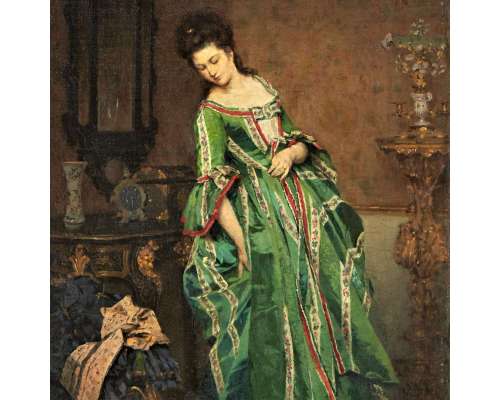
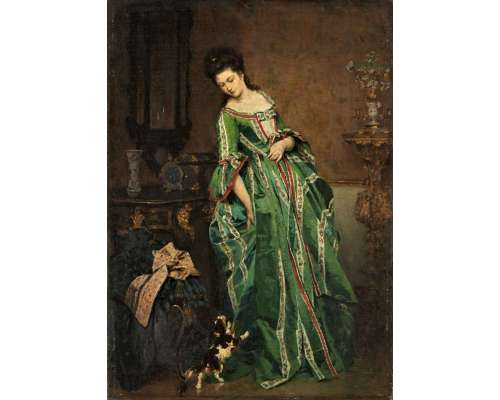
Beyond genre scenes, Linder's portraits of women are equally notable. These works often convey a sense of grace, dignity, and psychological depth. He had a particular talent for rendering the textures of fabrics and the delicate features of his subjects, bringing a lifelike quality to his canvases. Whether depicting a "Lady with dog" or other anonymous sitters, Linder managed to capture not just a likeness, but often an essence of personality, making his portraits compelling studies of individual character.
Notable Works and Legacy
While a comprehensive catalog of Lambert Linder's complete oeuvre might be challenging to assemble posthumously, several of his works are recognized through auction records and museum collections, offering insights into his creative output. Among his documented paintings is "A Quiet Afternoon," dated 1869, which has appeared at auction and achieved a record price for the artist in 2021. This suggests a timeless appeal in his ability to capture serene domesticity.
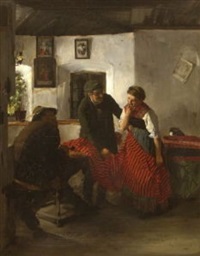
Other significant works include "Die Verführer" (1872), "Kirchgang in Oberbayern," and "Der Tuchverkäufer". The latter, also known as "DER STOFFHÄNDLER IN DER BAUERNSTUBE," vividly illustrates a common genre theme of merchant-customer interaction within a rustic setting, showcasing his narrative skill and attention to the details of daily life. The Bayerische Staatsgemäldesammlungen also lists works such as "In der Bäckerstraße" (before 1889) and "Flötenkonzert," further highlighting his versatility in depicting both urban scenes and musical pastimes.
Linder's art provides valuable historical documentation of 19th-century German life and societal norms. His legacy rests on his consistent quality, his mastery of academic techniques, and his ability to infuse traditional subjects with a sense of vitality and human interest. Though he lived and worked in an era before modern "awards" in the contemporary sense, the consistent presence of his works in reputable art auctions and their inclusion in public collections serve as enduring testaments to his artistic merit and lasting appeal.
Auction History and Recognition
While "awards" in the modern entertainment industry context are not applicable to Lambert Linder, the market for his work offers a form of recognition and validation of his artistic legacy. His paintings have consistently appeared in prominent auction houses, demonstrating a sustained interest from collectors and institutions. For instance, Artnet records four auction results for Linder, dating back to 2001, and MutualArt also tracks his auction presence.
The sale of "A Quiet Afternoon" in 2021, achieving a record price, signifies a renewed appreciation for his work in the 21st century. Other works like "Die Verführer" (1872), "Kirchgang in Oberbayern," and "Der Tuchverkäufer" have also found new homes through auction, with notable sales recorded in 2005 and 2001, among others. This active secondary market underscores the enduring value and aesthetic quality recognized by the art world, long after his passing. The presence of his works in the Bayerische Staatsgemäldesammlungen further solidifies his place in art history.

 EN
EN  NL
NL FR
FR