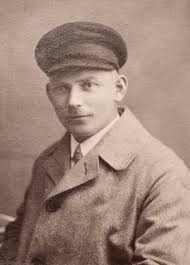
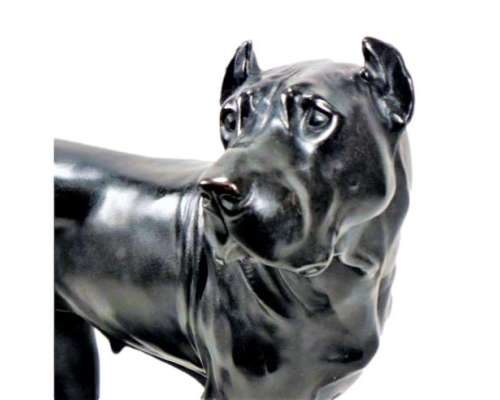
Gustav Reißmann (1887 - 1954)
Gustav Reißmann, born Karl Gustav Reißmann on March 17, 1887, in Neustadt bei Coburg, Germany, carved a significant niche for himself as a distinguished German sculptor during the early to mid-20th century. His artistic journey, marked by both academic rigor and personal resilience, led him to create a diverse portfolio of works, ranging from public monuments to intricate smaller sculptures and reliefs. Reißmann's life and career spanned a period of immense historical upheaval in Germany, including two World Wars, events that profoundly impacted his personal life and artistic trajectory. He is remembered for his dedication to his craft and the lasting beauty of his creations, many of which adorned public spaces and private collections.
Early Life and Artistic Foundations
Gustav Reißmann's artistic inclinations emerged early in his life. Born to Carl Moritz Reißmann, a "Bossierer" (a term often associated with mold makers or modelers, particularly in industries like porcelain or toys), and Maria Ernestine Dorn, he was exposed to craftsmanship from a young age. This familial background likely provided a foundational appreciation for form and material that would later define his sculptural practice. His hometown of Neustadt bei Coburg, with its rich traditions, also played a role in shaping his initial worldview.
His formal education began at the local Volksschule, the elementary school of his time. Recognizing his burgeoning talent, Reißmann pursued further artistic training at the Industrie- und Gewerbeschule in Neustadt, a vocational and industrial arts school. This institution would have provided him with fundamental skills and technical knowledge essential for any aspiring artist. The curriculum likely combined practical application with theoretical understanding, preparing him for more advanced studies in the arts.
A pivotal moment in Reißmann's early career occurred in the spring of 1905 when he moved to Dresden alongside his contemporary, Edmund Moeller. Dresden, a vibrant cultural hub, offered greater opportunities for artistic development. For three years, he attended the Kunstgewerbeschule (School of Arts and Crafts) in Dresden, immersing himself in various artistic disciplines and refining his technical abilities. This period was crucial for developing his aesthetic sensibilities and understanding of design principles.
His dedication and talent were recognized, leading to his acceptance into the prestigious Akademie der Bildenden Künste (Academy of Fine Arts) in Dresden in 1908. Beginning in Easter 1909, Reißmann studied in the renowned atelier of Professor Georg Wrba. Wrba was a highly respected sculptor known for his monumental works and his commitment to traditional craftsmanship while embracing modern influences. Studying under Wrba provided Reißmann with invaluable mentorship, exposing him to advanced sculptural techniques, anatomical studies, and the profound historical context of sculpture. This academic environment fostered his growth into a mature artist, equipping him with the skills and knowledge to embark on a professional career.
Impact of World War I and Post-War Resilience
Reißmann's promising academic journey was abruptly interrupted towards the end of 1913 with his conscription into military service. The outbreak of World War I meant that his artistic pursuits had to be set aside for the harsh realities of conflict. He served in the war, eventually returning as a lieutenant. The experiences of war undoubtedly left an indelible mark on him, both physically and psychologically. Upon his return, he faced a period of recovery, specifically needing to recuperate from a lung ailment, which was a common health issue for soldiers of that era.
Despite these challenges, Reißmann demonstrated remarkable resilience. After regaining his health, he established his own studio in Dresden. This marked the beginning of a period of significant artistic and economic success for the sculptor. His ability to resume his artistic practice and thrive in the post-war environment speaks volumes about his determination and the demand for his talent. His work during this time likely contributed to the rebuilding and aesthetic revitalization efforts in Dresden, a city that valued art and culture deeply.
Artistic Style and Key Sculptures
Gustav Reißmann's artistic style can be characterized by a blend of traditional craftsmanship and an ability to convey narrative and emotion through form. While specific stylistic movements he adhered to are not explicitly detailed, his training under Georg Wrba suggests an grounding in academic principles, possibly leaning towards expressive realism or a simplified, powerful classicism, typical of early 20th-century German sculpture. He worked across various scales, from intimate reliefs to substantial public monuments, demonstrating versatility in his application of sculptural principles.
Among his early notable works is the "Plastik Windspiel" (Sculpture Wind Chime) from 1908, an intriguing title that suggests an exploration of movement or perhaps a playful, dynamic form. In the same year, he contributed a significant relief to the gable of the prestigious Hotel Europäischer Hof in Dresden, located at Prager Straße 39, corner Sidonienstraße. This commission indicates his early professional recognition and ability to integrate art into architectural design.
In 1909, Reißmann created the bronze statue "Hirsch" (Deer) for the Lahmann-Sanatorium in Dresden, a testament to his skill in animal sculpture and his ability to work with naturalistic forms. Other works from this period include "Plastik Maurer" (Sculpture Mason) for the Krieger-Gedächtnis-Siedlung (War Memorial Settlement) in Neustadt bei Coburg, highlighting themes of labor or remembrance. He also contributed the "Vier Jahreszeiten" (Four Seasons), a figure group in the park of Bad Gottleuba, showcasing his aptitude for allegorical and thematic compositions. Additionally, he produced four agricultural groups for the Herrenhaus Großenhain, further demonstrating his engagement with figurative and thematic sculpture.
A significant public commission from 1928 was the "Zierbrunnen" (Ornamental Fountain) in the Kurpark Weißer Hirsch, Dresden. Fountains often serve as focal points in public spaces, requiring both aesthetic appeal and structural integrity, areas where Reißmann excelled. Another important work is the reconstructed "Hygieia-Brunnen" (Hygieia Fountain) in the Rathauspark on Weißen Hirsch in Dresden, depicting the Greek goddess of health, Hygieia, emphasizing themes of wellness and public welfare. The "Kriegerdenkmal" (War Memorial) in Haarbrücken stands as another powerful testament to his ability to commemorate significant historical events and honor those who served. These public works underscore his contribution to civic art and memorialization.
Awards and Recognition
Gustav Reißmann's talent and contributions to the arts did not go unnoticed. He received significant recognition from the very institution where he honed his skills: the Akademie der Bildenden Künste. He was awarded both the Silberne Staatsmedaille (Silver State Medal) and the Goldene Staatsmedaille (Gold State Medal). These prestigious awards from the State Academy of Fine Arts were a clear acknowledgment of his exceptional artistic merit, technical mastery, and the impact of his sculptural works. Such accolades cemented his reputation as a leading sculptor of his generation and affirmed his place within the German art scene.
The Devastation of World War II and Later Years
The prosperity and artistic flourishing that characterized Reißmann's middle career in Dresden were tragically brought to an end by the devastating events of World War II. On February 13, 1945, the infamous Allied air raids on Dresden obliterated much of the city, including its cultural heritage and countless private residences and studios. Gustav Reißmann was among the many who suffered immense losses, losing his entire property and livelihood in the catastrophic bombardments. This personal tragedy forced him to return to his hometown of Neustadt bei Coburg, penniless and having to rebuild his life from scratch.
Despite the profound setback, Reißmann's creative spirit endured. In Neustadt, he adapted his artistic skills to the local economy, primarily creating figures for the thriving domestic toy industry. This shift highlights his versatility and determination to continue his craft even under drastically changed circumstances. Alongside his work for the toy industry, he also continued to produce smaller, independent sculptures and reliefs, maintaining his connection to fine art. This period in his life demonstrates his unwavering dedication to creating, even when grander commissions were no longer feasible.
Legacy and Enduring Influence
Gustav Reißmann passed away in his hometown of Neustadt bei Coburg on January 22, 1954, at the age of 66. His life was a testament to the power of artistic dedication and personal resilience in the face of historical adversity. While the "albums" and "tours" of a modern artist are not applicable to a sculptor of his era, his legacy is preserved through his numerous extant works and historical records. His sculptures, particularly those that adorned public spaces in Dresden and Neustadt, stand as enduring testaments to his skill and artistic vision.
Reißmann's contributions to German sculpture, from his early academic achievements and prestigious awards to his later, more modest but equally skilled work, ensure his place in the annals of art history. His art continues to be studied and appreciated by historians and art enthusiasts interested in the early 20th-century German art scene. The preservation and restoration of works like the Hygieia-Brunnen highlight a continued appreciation for his artistic contributions, ensuring that future generations can experience the beauty and historical significance of Gustav Reißmann's sculptural artistry.

 EN
EN  NL
NL FR
FR