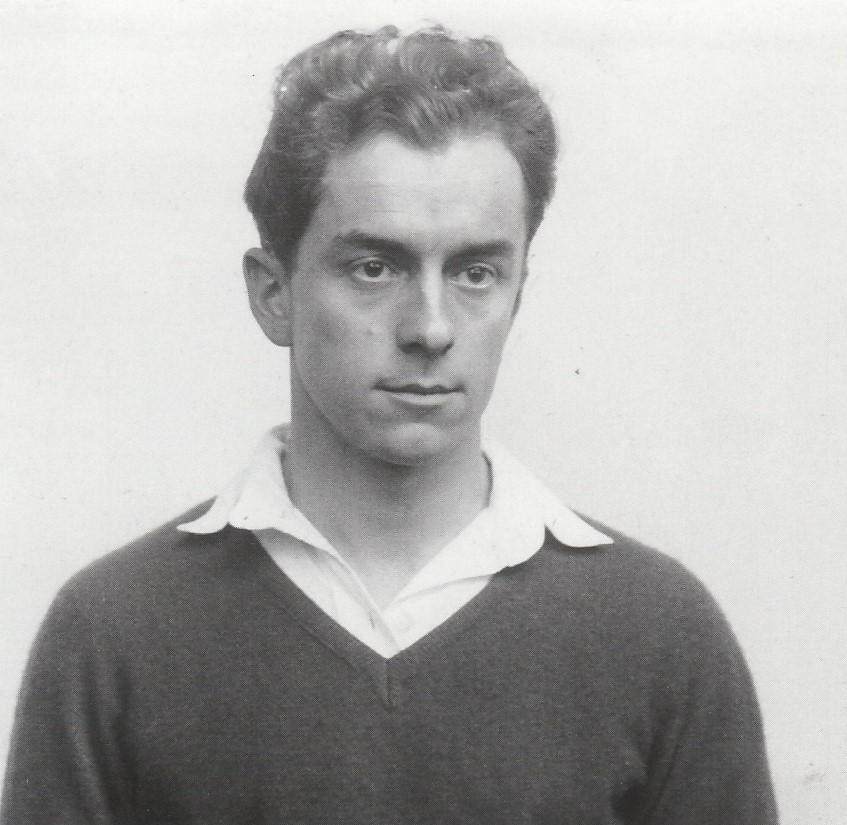
Willy Kreitz is one of the most fascinating figures in 20th-century Belgian art, a master sculptor whose life was defined by a remarkable duality: the discipline of the athlete and the passion of the artist.
A Dual Calling: The Studio and the Sports Field (1903-1924)
Born in Brussels in 1903, Willy Kreitz showed an early talent for drawing. He enrolled at the Royal Academy of Fine Arts in Brussels, where he was trained by masters like Victor Rousseau. His hands were already shaping the future of sculpture.
But Kreitz had another arena: the hockey pitch. A powerful and gifted athlete, he was selected for the Belgian national team. In 1924, he reached the pinnacle of sport, winning a silver medal at the Paris Olympic Games. This dual life—between the artist's studio and the sports field—forged his unique perspective: a relentless quest for the perfect form, for mastered power, and for elegance in motion.
The Rise of a Sculptor: The Art Deco Years (1920s-1930s)
After his Olympic success, Kreitz dedicated himself entirely to sculpture. The 1920s and 30s were the heyday of Art Deco, and his style fit perfectly into the movement. He favored geometric forms, extreme stylization, and a sophisticated, streamlined elegance.
His favorite subject quickly became the animal: the horse, the greyhound, the bull, and the panther. Kreitz was not interested in naturalistic realism. Instead, he sought to capture the life force, the raw power, and the speed of his subjects. His sculptures are nervous, tense, and seem perpetually ready to leap. He froze movement into matter.
In 1935, he created one of his most iconic works, the Centaur, for the Brussels World's Fair. This monumental piece perfectly symbolizes the fusion of man and animal, of the athlete and the artist.
Maturity and Abstraction: The Post-War Period
After World War II, Kreitz's style evolved. While keeping animals as his muse, he moved away from strict geometry toward more organic, fluid, and expressive forms. His sculptures gained an intense internal tension, a "nervous energy." The material—bronze or stone—seems alive, vibrating with inner force.
His international fame grew. He exhibited at the Venice Biennale, represented Belgium at the São Paulo Biennale, and won the sculpture prize at the Carnegie Institute in Pittsburgh (1961). His works were acquired by museums and collectors worldwide. He also became a professor at the Brussels Academy, passing on his rigor and passion to new generations.
The Man and His Legacy
Willy Kreitz died in 1982, leaving behind a vast and coherent body of work. His legacy is defined by:
- The man-animal duality: He gave his animals a soul and a nearly human strength.
- The fusion of sport and art: His anatomical knowledge, honed on the sports field, allowed him to depict the moving body with unparalleled accuracy.
- Mastery of form: From geometric stylization to abstract expressionism, he explored the full spectrum of modern sculpture.
Today, his monumental sculptures grace public spaces across Belgium (like the Bull at the Heysel or the Rearing Horse in Waterloo), and his smaller bronzes are highly sought after by collectors. Willy Kreitz remains a unique figure, the embodiment of the complete artist, where the physical strength of the Olympian was transmuted into artistic sensitivity of rare intensity.
Key Works:
- Centaur (1935)
- The Rearing Horse (multiple versions)
- Bull (monumental version for Expo 58)
- Panther (multiple bronze versions)
- Greyhound
- Numerous portraits of public figures (including King Baudouin)

 EN
EN  NL
NL FR
FR