
 EN
EN  NL
NL FR
FR
Last items in stock
Alfredo Pina, an eminent Italian-French sculptor, forged a distinctive path in the early 20th century art world, leaving behind a legacy of powerful and emotionally charged bronze and marble works. Born in Milan, Italy, in 1883, Pina’s artistic journey was deeply rooted in classical training yet propelled forward by the burgeoning Modernist movements of his era. He is celebrated for his expressive portrait busts and dynamic figurative sculptures, which frequently explore themes of human emotion, struggle, and resilience. His profound admiration for Auguste Rodin significantly shaped his unique sculptural style, characterized by its impetuous forms and psychological depth.
Pina's career spanned both his native Italy and adopted France, where he became a naturalized citizen later in life. His works are held in prestigious collections worldwide, affirming his enduring impact on modern sculpture. Through his extensive exhibitions and collaborations with renowned foundries, Pina secured his place among the notable sculptors of his time, constantly seeking to capture the inner turmoil and grandeur of the human spirit in his chosen mediums. His artistic narrative is one of unwavering dedication to his craft, marked by significant recognition and an adventurous spirit that embraced the artistic ferment of his age.
Alfredo Pina's formative years began in Milan, Italy, where he was born in 1883. Tragically orphaned at the young age of twelve, Pina found solace and direction in art. His formal education commenced at the prestigious Accademia di Belle Arti di Brera in Milan, an institution famed for nurturing artistic talent. Here, he honed his skills in sculpture under the tutelage of Professor Alessandro Broggi, absorbing the foundational principles of classical art while beginning to explore his own expressive inclinations.
His academic excellence was quickly recognized when, in 1904 (or 1906, according to some sources), he was awarded the Grand Prix Nazionale di Scultura Italia, a significant national prize for sculpture. This early triumph marked a pivotal moment in his career, establishing him as a rising talent within the Italian art scene. Following his studies in Milan, Pina continued his artistic development by spending time in Bologna and Rome, further enriching his understanding of historical and contemporary Italian sculpture.
The allure of the thriving Parisian art world, particularly his admiration for the monumental work of Auguste Rodin, soon drew Pina beyond Italy's borders. Around 1906, or possibly 1911, he relocated to Paris, a move that would profoundly influence the trajectory of his artistic expression. He established a studio in Sceaux, immersing himself in the vibrant artistic circles of the French capital and seeking direct engagement with the masters he admired.
Upon his arrival in Paris, Alfredo Pina sought to deepen his craft by working in Auguste Rodin's atelier between 1909 and 1910. This period of direct exposure to Rodin's revolutionary approach to sculpture proved transformative. Pina was profoundly influenced by Rodin's powerful modeling, dynamic compositions, and ability to convey intense emotion through form. The impact of Rodin's turbulent masterpiece, "The Gates of Hell," is particularly evident in Pina's subsequent works, which often share a similar sense of dramatic intensity and psychological depth.
Beyond Rodin, Pina also studied under Antoine Bourdelle, another significant figure in French modern sculpture, further broadening his artistic perspectives. His style evolved to embrace Modernist and Expressionist characteristics, moving away from strict academic realism. Pina’s sculptures are distinguished by their abrupt and sometimes unfinished forms, which contribute to their raw emotional power. He excelled at depicting bodies twisted by passion or pain, imbuing his figures with an impetuous and emotionally charged tone.
This Rodinesque "play of form" in Pina's modeling deliberately prioritized a generalized depiction of inner emotion over precise anatomical detail. His busts, in particular, emphasize the psychological expression of his subjects, often with a hallmark focus on the intensity conveyed through the eyes. Pina's work resonated with the themes of Symbolism and Expressionism, capturing the internal struggles and resilience of the human condition. He masterfully used the tactile qualities of bronze and marble to convey the tension and dynamic energy of his subjects.
Alfredo Pina's oeuvre encompasses a wide array of subjects, with a particular focus on portrait busts of notable figures and evocative nudes. His ability to capture the essence of his subjects, coupled with his expressive style, made his portrait busts highly sought after by collectors and museums. Among his most celebrated works are those depicting renowned composers and writers, which have become a significant part of his artistic legacy.
One of his prominent works is the "Bust of Beethoven," modeled during the First World War in Montpellier. This piece, notable for its expressive attitude and powerful portrayal of the composer's genius, was later acquired by the Montpellier museum and widely reproduced. Pina also created an impactful "Bust of Victor Hugo," a bronze group first presented at the Salon of 1914, which is now housed in the Metropolitan Museum in New York City. Another significant portrait includes his "Bust of Wagner," with a small version acquired by the National Gallery in Washington.
Beyond portraiture, Pina explored mythological and allegorical themes. His sculpture "Icarus," or "Icarus Fallen," depicts the tragic hero collapsed on rocks after his ill-fated flight, showcasing his ability to render dramatic narratives in three dimensions. The sculpture "Le Baiser" (The Kiss) openly references Rodin's iconic work of the same name, reflecting Pina's ongoing dialogue with his mentor's influence while asserting his own interpretive vision.
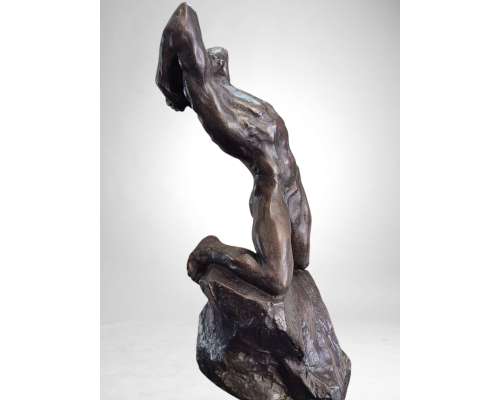
Perhaps one of Pina's most compelling works is "Extreme Effort" (Le Suprême Effort), a striking bronze sculpture embodying the raw struggle and perseverance of the human spirit. This piece portrays a muscular male figure in intense exertion, his body twisting in a defiant gesture, highlighting the textural contrast between the rock and the figure's anatomy to enhance its dramatic intensity. "Extreme Effort" is well-documented and frequently appears in major auctions, attesting to its significance within Pina's body of work.
Pina's artistic productivity extended to monumental commissions, including projects for monuments commemorating the fallen of the First World War. Notably, he won a competition launched by Benito Mussolini for the project of the tomb of Dante Alighieri. Although the bronzes for this grand undertaking were later diverted for other uses during World War II, this commission underscores the high regard in which Pina's work was held. He also sculpted a bust of Mussolini, which was exhibited at the 1926 Salon.
His collaboration with esteemed foundries, particularly Valsuani (from around 1920) and Montagutelli, was crucial to the dissemination of his work. These partnerships ensured that his powerful figures, busts, and sculptures were expertly cast and distributed, significantly boosting his commercial opportunities and making his art accessible to a wider audience. He also worked with Les Neveux de Jules Lehmann.
Throughout his career, Alfredo Pina was a prolific exhibitor, regularly showcasing his work in prominent salons and exhibitions across Europe and beyond. In Italy, he consistently exhibited his sculptures until his move to Paris. Once in France, he quickly integrated into the vibrant Parisian art scene, becoming an Associate member of the Salon des Artistes Français in 1911 and exhibiting there between 1911 and 1914.
Pina was also a frequent participant and, notably, a jury member of the Salon d'Automne from 1911, an important platform for innovative currents in art. His works were also seen at the Salon des Artistes Indépendants and the Salon des Tuileries, particularly from around 1920. These exhibitions provided critical exposure for his Modernist and Expressionist sculptures, allowing him to connect with an appreciative public and influential critics.
His international reach extended across the Atlantic, with notable exhibitions in New York City in 1931, further solidifying his reputation on a global scale. Pina also participated in the prestigious Biennale di Venezia in 1920 and 1922, presenting his significant works, including a full-size bust of Beethoven. In 1921, he received a "mention honorable" at the Salon d'Automne, a testament to the continued high regard for his contributions to contemporary sculpture.
In 1922, Pina made a significant personal and professional decision, moving permanently to Mesves, France. This transition culminated in him becoming a naturalized French citizen in 1939. Even in his later years, he continued to exhibit his work, including shows in Nevers and Vézelay, where he participated in an exhibition of religious art. His active involvement in various artistic circles, particularly those of Montparnasse, underscored his deep connection to the evolving art world of his time.
Alfredo Pina passed away in Mesves, France, on December 22, 1966, leaving behind a substantial body of work that continues to captivate collectors and art enthusiasts. His estate from the workshop was bequeathed to the museum in Charité-sur-Loire, ensuring the preservation and study of his artistic output. Pina's sculptures are regularly featured in auction houses worldwide, with significant prices achieved, reflecting the sustained demand and appreciation for his unique blend of classical training and Modernist expression.
Museums and private collections globally house his works, cementing his place as an important sculptor of the early 20th century. His busts of historical figures like Beethoven and Victor Hugo, along with his emotive allegorical pieces such as "Extreme Effort," remain powerful examples of his ability to infuse bronze and marble with profound psychological depth. Pina's legacy lies in his skill to transcend mere representation, offering instead a window into the raw intensity of human experience through his sculpted forms.
The consistent appearance of his works in major exhibitions and art market databases like Artnet and MutualArt underscores the ongoing scholarly and commercial interest in Alfredo Pina. His influence, primarily through his Rodin-esque yet distinctively expressive style, continues to be studied by art historians. Pina's contribution to modern sculpture is characterized by his audacious embrace of emotional intensity and dynamic form, ensuring that his artistic voice continues to resonate with contemporary audiences.
Close filter window

